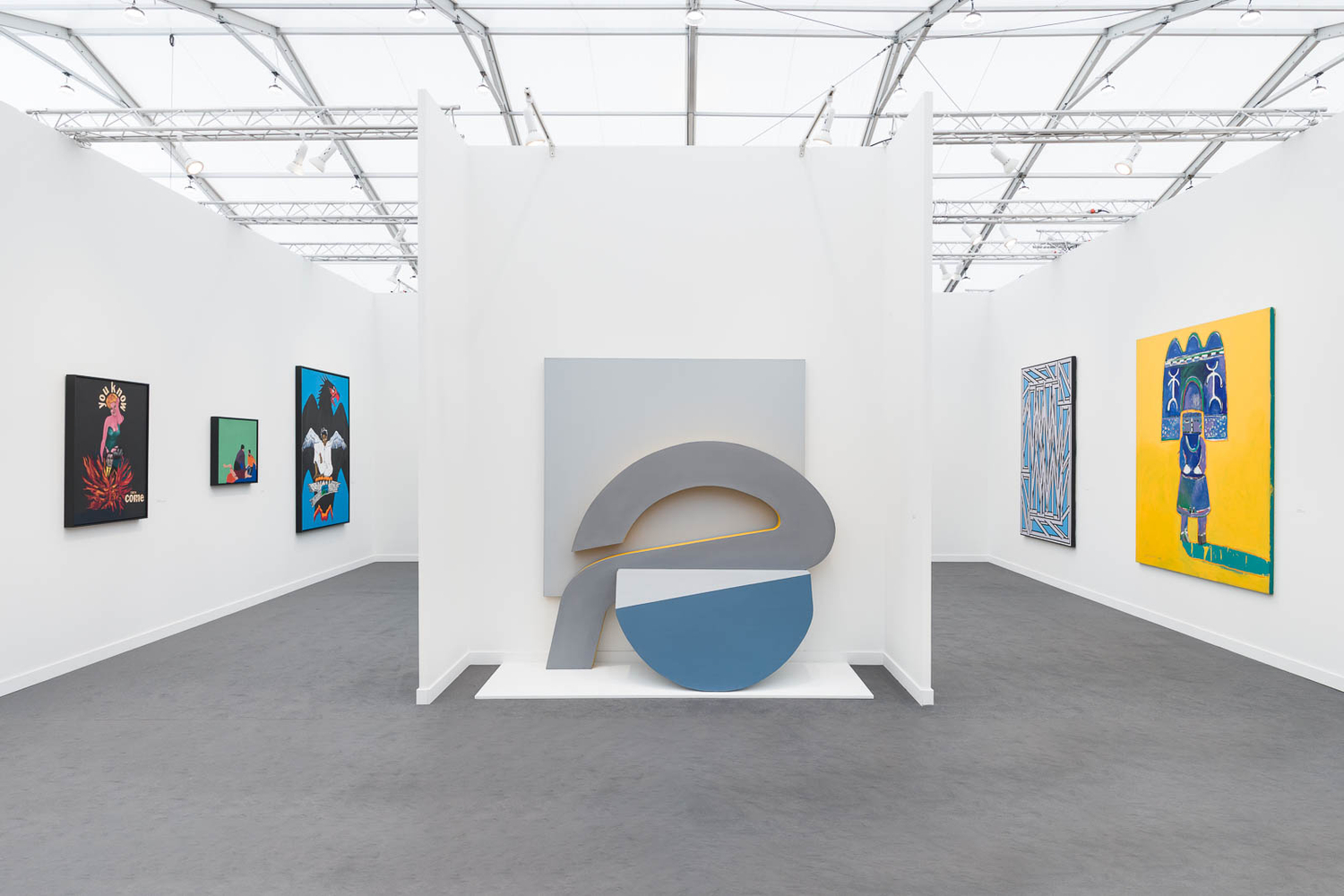
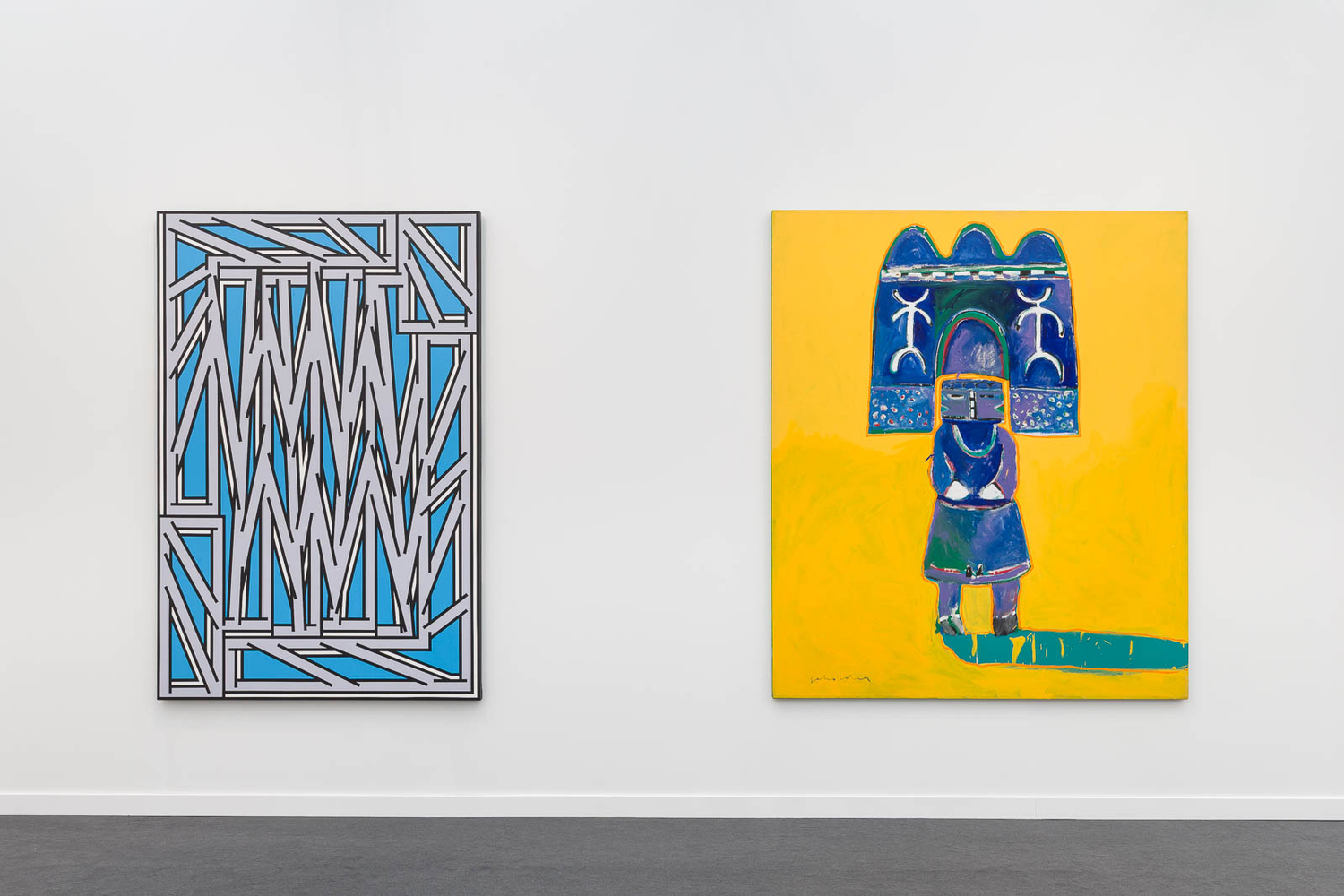
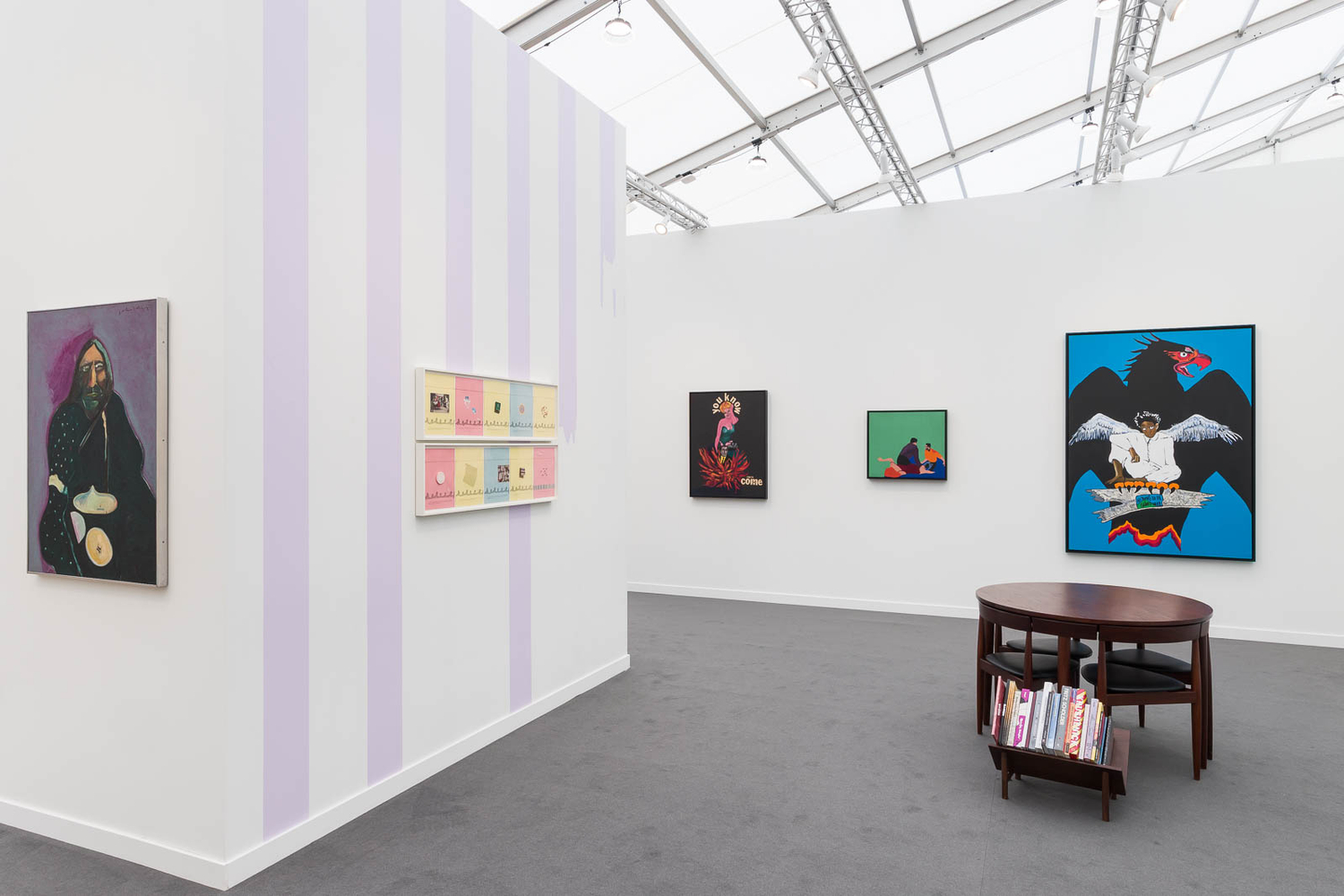
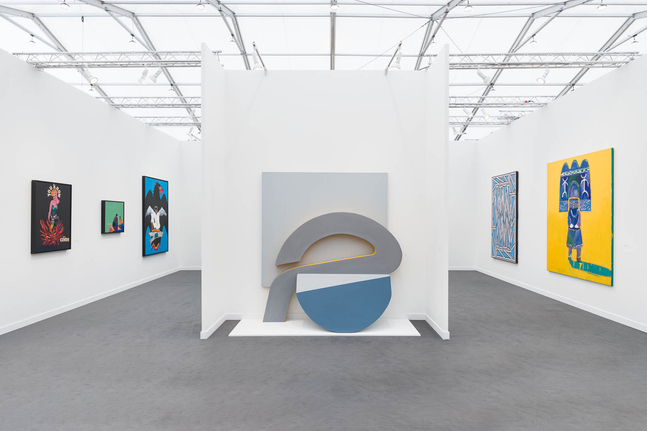
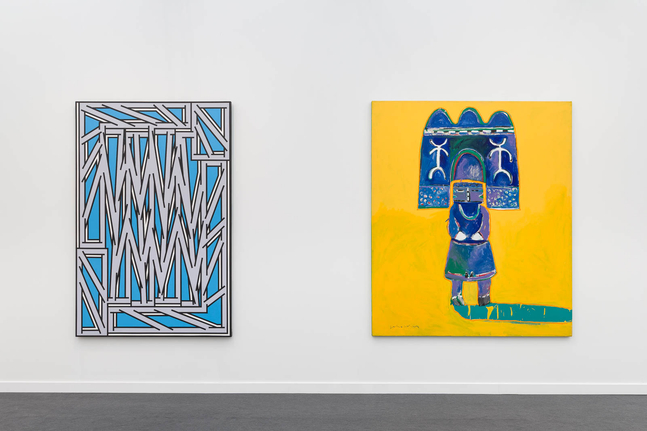
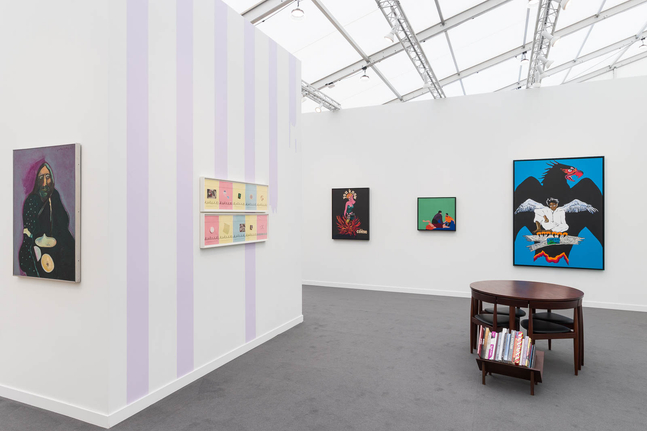
For the 2026 edition of Frieze Los Angeles, Garth Greenan Gallery is pleased to present works by Melissa Cody, Rosalyn Drexler, Nicholas Krushenick, Sven Lukin, Howardena Pindell, Fritz Scholder, Jasmin Sian, Alexis Smith, and Emmi Whitehorse.
Frieze Los Angeles will take place at Santa Monica Airport from February 26 to March 1, 2026, opening to the public the afternoon of February 27. Garth Greenan Gallery will be at booth A17.
Born in No Water Mesa, Arizona, Melissa Cody (b. 1983) is an enrolled member of the Navajo Nation. A fourth-generation weaver, Cody creates tapestries that draw on the tradition of Germantown Revival, a stylistic movement that emerged from the Long Walk or Hwéeldi. For Cody, this century-old genre of weaving—characterized by vivid colors and bright, dazzling designs—is simultaneously an expression of history and a powerful vehicle for picturing contemporary life: “I’m a child of ’80s video game culture,” she says. “Pac-Man, Frogger, Nintendo. I grew up with this world of pixelation.”
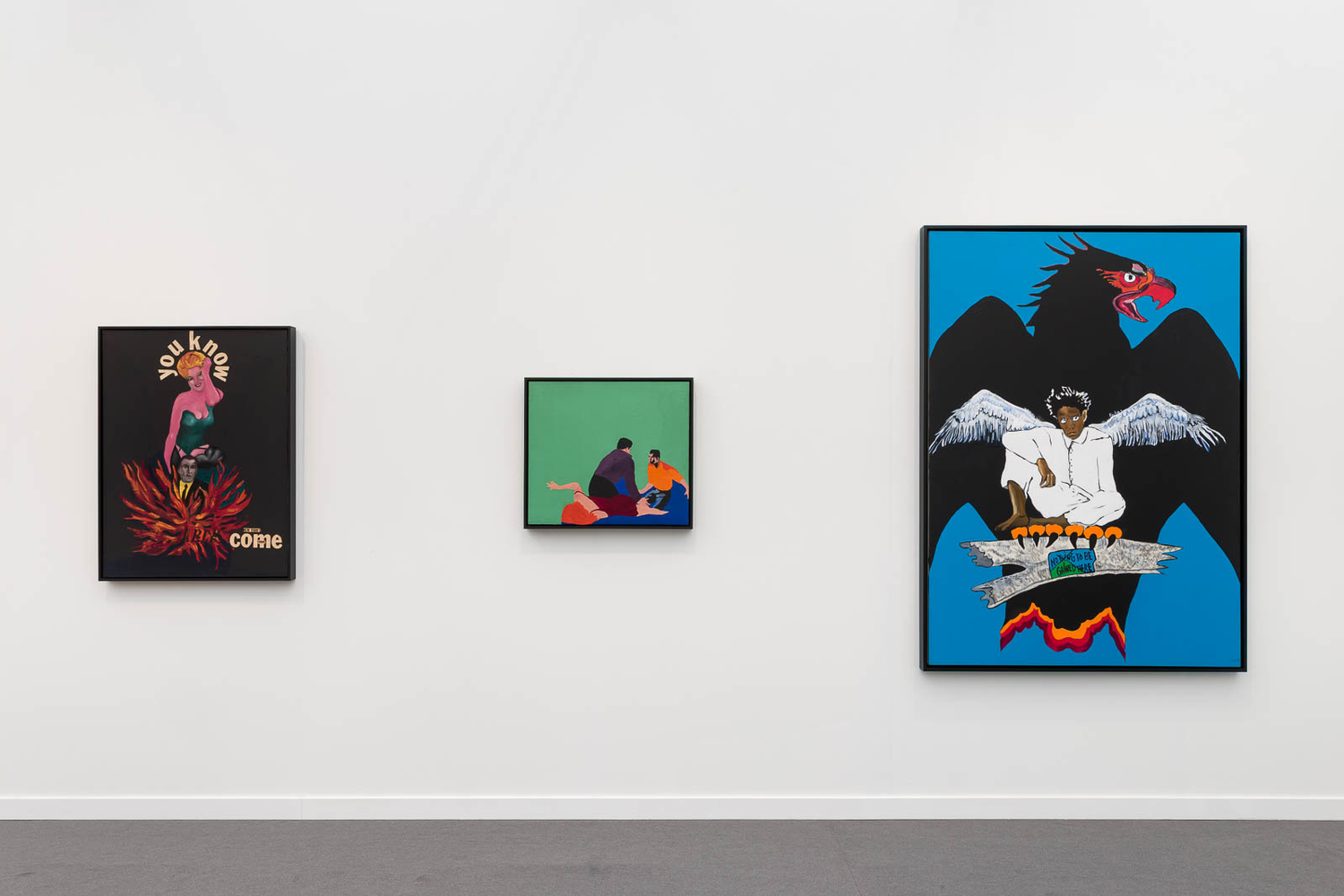
Rosalyn Drexler (1926–2025) was born in the Bronx, New York. Part of the original generation of American Pop artists, Drexler began using commercial imagery in the early 1960s—at the same time as Andy Warhol and Roy Lichtenstein. Only recently, however, has she received critical recognition for this achievement. Graphically intense and thematically dark, Drexler’s artworks channel the sinister undercurrents of American life, summoning themes of sexuality, fame, and violence. On view in the gallery’s booth are three works: two from the watershed period of the early 1960s, and a portrait of Jean-Michel Basquiat from 1989.
Born in the Bronx, New York, Nicholas Krushenick (1929–99) studied painting at the Art Students League of New York and the Hans Hofmann School of Fine Arts. The loose geometries and web-like forms of his early 60s “pop abstract” paintings demonstrate his deliberate caricature of Abstract Expressionist “drips” or “skeins” into what more closely resemble details from cartoons—like Superman’s hair follicles, as critic Robert Rosenblum once described.
Born in Riga, Latvia, Sven Lukin (1934–2022) was a New York–based painter, draftsman, and sculptor whose brilliantly colored, audaciously three-dimensional work mounted a challenge to the era’s high-modern orthodoxies. Christened the “father of the shaped canvas” by the New York Times in 1968, Lukin wielded canvas, Styrofoam, and burlap-on-wood to create painting-sculpture hybrids that bulge and protrude into real space. Defined by their highly finished surfaces, immense curvilinear forms, and a bright, California-modernist palette, Lukin’s artworks are a testament to the myriad possibilities—and visceral power—of color, shape, and mass.
Howardena Pindell (b. 1943) is a New York-based artist born in Philadelphia. A key member of a small group of Black abstract painters, including Jack Whitten, Al Loving, and Sam Gilliam, Pindell developed a multifaceted art practice that fused deeply political commitments with a rigorous inquiry into the medium of painting. Untitled #21 (HP/DNA/Bahamas) (2023) is one of Pindell’s cut-and-sewn canvases, featuring dense, brilliantly colored accumulations of paint and paper dots.
Born in Breckenridge, Minnesota, Fritz Scholder (1937–2005) was an enrolled member of the Luiseño tribe. A major influence for generations of Native artists, Scholder is best known for a groundbreaking series of paintings from the 1960s and 70s that depict brutal scenes of alcoholism, poverty, and the cultural subjugation of Native Americans. “People say that I must hate Indians since I sometimes paint them as monsters,” Scholder wrote in 1973. “But I paint what I see, faces reflecting the torment in the minds of Indians today, torment resulting from the impositions on them of contemporary American society.”
Jasmin Sian (b. 1969) is a New York–based artist. Featuring in the 2026 Whitney Biennial. Sian’s exquisitely detailed cut-paper works depict plants, animals, and landscapes with materials such as graphite, gouache, and recycled materials like brown paper deli bags and bubblegum wrappers. Reminiscent of decorative lace, her artworks are the products of a laborious process of tracing and carefully excising salvaged paper into thin, floriated designs. “I like things that are abject,” she says, “and that transformative process.”
Recognized for her meticulously crafted mixed-media collages, Alexis Smith (1949–2024) combines images, objects, and texts rescued from the detritus of popular culture—pulp novels of the '40s and '50s, postcards, road maps, movie stills, and advertising art—into witty, often sardonic statements. In much of her work, the city of Los Angeles is a favored subject: Smith exploits the universal allure and fascination around Hollywood as the quintessential American transformational myth, the American urge to “make it big.”
An enrolled member of the Navajo Nation, Emmi Whitehorse (b. 1957) is an artist based in Santa Fe, New Mexico. Her paintings—four examples of which appeared in the 2024 Venice Biennale—feature atmospheric fields of diffuse and shifting color that teem with elemental forms. Meditative and slow, Whitehorse’s painting is rooted in the Navajo philosophy of Hózhó, a concept connoting beauty, order, harmony, and balance. “My paintings tell the story of knowing land over time,” she says, “of being completely, microcosmically within a place.”